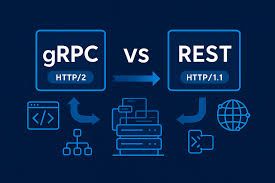
In the world of modern API development, two heavyweights dominate the conversation: the battle-tested REST and the high-performance challenger gRPC.
If you are building a microservices architecture or a new web application, choosing the right communication protocol is one of the most critical decisions you will make. Pick the wrong one, and you might face scalability bottlenecks or unnecessary complexity down the road.
In this post, we’ll dive deep into the differences between REST and gRPC, compare their performance, and help you decide which one is right for your specific use case.
The Basics: What are they?
REST (Representational State Transfer)
REST is the "standard" architectural style for building web APIs. It treats data as resources (like a User, an Order, or a Product) that can be accessed via standard HTTP methods (GET, POST, PUT, DELETE).
- Format: Typically JSON (text-based).
- Transport: Usually HTTP/1.1 (though works on HTTP/2).Philosophy: "Resource-oriented."
- Philosophy: "Resource-oriented.
gRPC (Google Remote Procedure Call)
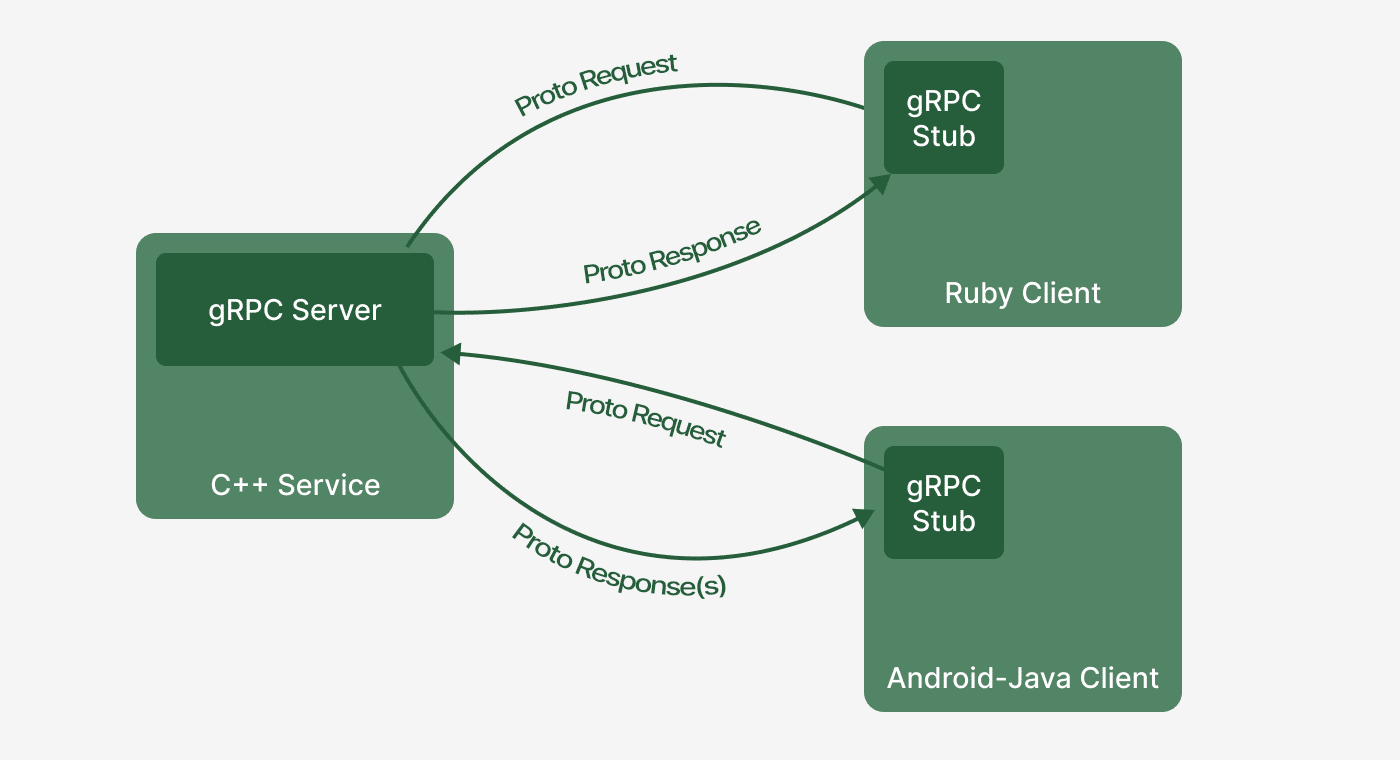
Developed by Google, gRPC is an open-source framework that allows you to define methods on a server and call them directly from a client application as if they were local functions.
- Format: Protocol Buffers (binary).
- Transport: HTTP/2 (strictly).
- Philosophy: "Action-oriented" (Remote Procedure Call).
Key Comparisons
1. Data Format & Payload Size
- REST (JSON): JSON is human-readable, which makes debugging easy. However, it is text-based and repetitive. Sending a list of 100 users means repeating field names like "name" and "id" 100 times, bloating the payload size.
- gRPC (Protobuf): gRPC uses Protocol Buffers, a binary format. It serializes data into binary streams, making payloads significantly smaller (often 7–10x smaller than JSON). This results in faster transmission, especially useful for low-bandwidth networks.
2. Performance & Speed
gRPC is almost universally faster than REST, primarily due to HTTP/2.
- Multiplexing: HTTP/2 allows multiple requests and responses to be sent over a single TCP connection simultaneously. REST on HTTP/1.1 typically requires a new connection for each request (or uses "keep-alive" sequentially), which causes head-of-line blocking.
- Serialization: Parsing binary data (Protobuf) requires less CPU power than parsing text (JSON).
3. Streaming Capabilities
- REST: Strictly follows a Request-Response model. If you need real-time updates, you have to use workarounds like Long Polling or implement a separate technology like WebSockets.
- gRPC: Has native support for streaming. It supports: server streaming, client streaming, bidirectional streaming.
4. Browser Support
This is REST's stronghold.
- REST: Fully supported by every web browser. It is the natural language of the web.
- gRPC: Browsers do not currently support gRPC out of the box because they don't expose enough control over HTTP/2 frames. To use gRPC in a web app (React, Vue, etc.), you must use a proxy tool like gRPC-Web, which adds complexity.
5. Developer Experience
- REST: Flexible but loose. You typically need third-party tools (like Swagger/OpenAPI) to document your API. It's easy to make mistakes if the documentation drifts from the code.
- gRPC: Strict and safe. You define a .proto file (a contract) first. From this file, gRPC automatically generates client and server code in almost any language (Go, Python, Java, C#, etc.). This ensures type safety and that the client and server are always in sync.
Summary Comparison Table
When to Use Which?
Choose REST if:
- You are building a public API: If you want third-party developers to access your data easily, REST + JSON is the universal standard.
- You are building a frontend web application: Since browsers speak REST natively, it is much simpler to integrate with JavaScript frameworks without needing proxies.
- Speed development is a priority: REST is faster to "hack together" initially because you don't need to define strict contracts or compile .proto files.
Choose gRPC if:
- Internal Microservices: If you have Service A talking to Service B inside your backend, gRPC is the clear winner for speed and efficiency.
- Polyglot Environments: If Service A is written in Python and Service B in Go, gRPC's code generation handles the translation layer perfectly.
- Real-time / Streaming needs: For chat apps, live video feeds, or IoT device data streams.Low-latency requirements: When every millisecond counts (e.g., financial trading systems or gaming).
Conclusion
Neither technology replaces the other; they solve different problems.
Think of REST as the "universal language"—it’s flexible, easy to read, and works everywhere. Think of gRPC as the "specialized high-speed tunnel"—it’s strict and requires setup, but once it's running, it moves data incredibly fast.
References
- https://aws.amazon.com/compare/the-difference-between-grpc-and-rest/
- https://shiftasia.com/community/grpc-vs-rest-speed-comparation/
- https://blog.postman.com/grpc-vs-rest/
- https://medium.com/@i.gorton/scaling-up-rest-versus-grpc-benchmark-tests-551f73ed88d4